

I've been going into my calculus classes to teach with fewer and fewer notes this semester. I've got a few examples in mind, but that's about it. And I really think it is going well. I think it helps that I started this way on the first day. I also seem to have a pretty good class - I've certainly been pleased so far. After today's class, and some others recently, I'm starting to think that posing the same question to my class a few times, either asking for a different solution, or just a differently-stated solution, is a good habit.
Last week we were talking about improper integrals in class. After some introductory discussion, I asked them to tell me which of the integrals, $\int_1^{\infty} \frac{e^{\sqrt{x}}}{\sqrt{x}}\ dx$ or $\int_1^{\infty} \frac{1}{\sqrt{x}e^{\sqrt{x}}\ dx$ could possibly converge, and why. The first answer I got was to actually compute the first integral and notice that it diverges, so that couldn't be it. A good answer, certainly, with an opportunity to talk about $u$-substitution with improper integrals. And then I asked again, for another reason. A student brought up the integral $\int_1^{\infty} \frac{1}{\sqrt{x}}\ dx$, which we already knew diverged, and this gave us the chance to talk about the comparison test. I think at this point we about ran out of time, but I know somewhere in there we also had a discussion about functions that approach 0 not necessarily having a convergent improper integral to infinity. We didn't get to L'Hospital's rule (hopefully a reminder, this being calc 2) that day, but did eventually, with this same example.
Today I was talking about parametric curves. I asked them to take a few minutes to try to sketch the parametric curve $(t^2-1,t^3)$, and then had students come to the board to draw what they had. I was happy to get two different answers - something like a sideways parabola, and then the correct graph, with a cusp. I asked them how we could tell which could possibly be the correct graph, because they both went through the first few easy points, (0,-1), (-1,0), and (0,1). A student pointed out that $y$ was changing faster than $x$, so it shouldn't be the sideways parabola. I didn't want to talk about concavity just yet, but we did get to it eventually.
Then I asked basically the same question, drawing three different curves that weren't the sideways parabola. One had a cusp at (-1,0) where the derivative approached 0 from both sides, another had a cusp where the derivative approached +/-1 (or so), and the third had a vertical asymptote at (-1,0), almost like the graph of $e^{-x^2}$ flipped sideways. I asked which of these it could possibly be, several times. I was delighted to get lots of answers, and continue to pressure the students to reformulate their answers to try to be more precise. I like to think that I waited through the quiet moments while students were working on more answers, or reformulating old answers. I like to think that's what they were doing, instead of just waiting for me to tell them the answer.
I love the feeling that nobody in the class is talking (me especially) because everybody is thinking hard about the same question. I hope that was actually the case with the quiet moments today. I think this process of asking the same question a few ways, or asking for students to answer it a few ways, and me harassing them about their answers, is a good process. We're not just going through "routine" calculations, and I like that. I also hope that I can continue to get lucky with examples that I can do this with.
Wednesday, September 9, 2009

Monday, September 7, 2009
Parametric Explorer
If you've been following my twitter stream the past few days, you may have noticed that I've been mentioning (and shamefully linking to) a webpage I've been working on to explore parametric curves. Today I decided to make another round of improvements and it was going well, so I thought I'd share here as well. I like to think it is something that calculus teachers might find useful.
Anyway, the page is sort of introduced on my personal website, and the actual "play around with this" page is here. I've only gotten it to work in Firefox 3.5 and Google Chrome. That's enough for me to play with it, so I don't intend to do much more in terms of browser compatibility work on it.
The idea is that your mouse coordinates describe a parametric curve as you move around the screen. The webpage then also graphs the individual curves $x(t)$ and $y(t)$.
There's certainly room for improvement, but I'm happy enough with it as it is to not worry about it for now.
Anyway, the page is sort of introduced on my personal website, and the actual "play around with this" page is here. I've only gotten it to work in Firefox 3.5 and Google Chrome. That's enough for me to play with it, so I don't intend to do much more in terms of browser compatibility work on it.
The idea is that your mouse coordinates describe a parametric curve as you move around the screen. The webpage then also graphs the individual curves $x(t)$ and $y(t)$.
There's certainly room for improvement, but I'm happy enough with it as it is to not worry about it for now.
Tuesday, August 25, 2009
First Day
Today was the start of yet another semester at the University of Virginia. The last few days I've been depressed and frustrated and probably a whole host of other negative things, but I think "the routine" starting back up again is helping me out of it. Nice to know that I still love teaching. It also helps that I have friends that treat me far better than I deserve, but that's a story for another day, perhaps.
I had my first class this morning. In fact, I had an 8am class, so I was one of several instructors who taught students their first college class ever. Kinda a fun thought. I hope I didn't screw it up too bad.
I'm teaching Math 132 again, which is Calculus II for math/science folks. I enjoy the course. Which is nice, since this is my fourth time in a row teaching it.
Since I've taught this course several times recently, I'm pretty comfortable with how the material flows, and how I want to make it flow. That, coupled with whatever nonsense I was going through this last weekend, means I hardly prepared for today at all. I had in my mind that I was going to walk in and ask students to tell me about integrals. Just whatever they knew, completely open ended. About 20 minutes before class started I thought maybe it'd be good to review a couple basic derivative rules too - power, e^x, sin, cos. We also talked about some trig identities, since students brought it up.
It's always fun to ask a group of 30-40 students what an integral is. You're bound to get many answers, and I've always been pleased that many of them were ones I had hoped for. It's also interesting to hear ones you weren't expecting. Today we talked through antiderivatives being derivatives "the other way". When asked what antiderivatives were, there was a lovely pause after I fained ignorance about what "the other way" meant ("write it right to left? bottom to top?"). I could feel the class thinking about another way to say this. We got around to it in time. Then we moved on to definite integrals as areas under the curve (but, really, between the curve and the axis, and really the signed version of that). And how they are related to Riemann sums, and how that was different from just a finite sum of rectangles (and did rectangles have to be below the curve? all the time?).
It was a great discussion. I had a wonderful time, and the students seemed to be reasonably content as well. I was shocked to hear what sounded like an entire classroom full of students tell me the derivatives of several functions, basically in unison. At 8:15 in the morning. I hope they can maintain this energy throughout the semester.
I also hope that the course setup can be like this many days, where it's not so much a lecture as a group discussion, with them leading the way. We'll see how that goes. I'm not expecting to try it all of the time. I'm sure that carefully planned examples will be a necessity before too long. I get kinda frustrated thinking about which examples to work. No matter what I do, the problems will always be easier when the students watch me do them, or we work through it together in class. They have to try problems themselves. They have to get stuck. It's the pain about math.
We meet again tomorrow, though, thankfully, not nearly as early. Tomorrow we start techniques of integration, kicking things off with "undoing the chain rule" (u-substitution), and perhaps hinting at "undoing the product rule" (parts), depending on timing. After that, I'm making them learn the other techniques on their own. The other techniques frustrate me. They're not techniques of integration - they are algebraic manipulations to try that come up in lots of integral problems (the problems that show up in calc textbooks anyway). And I would have no idea how to respond if a student asked why they are useful. They're doable by machine (wolframalpha.com, we've been through this before). My hope with making them learn this by themselves, from the textbook (and I encouraged them to find things online, and share what they found with the class), is that the exercise becomes "learn how to learn math by yourself" (well, starting off by yourself, and finding help where you can) instead of "learn these particular tricks". In the long run, that's a more useful thing anyway. In the short run, it might cause some issues, since the midterm will have a hard time testing if they've learned how to learn math by themselves. After they've turned in their first assignment on these techniques, I'll do some review in class, and then give them some more practice problems before the exam.
I had my first class this morning. In fact, I had an 8am class, so I was one of several instructors who taught students their first college class ever. Kinda a fun thought. I hope I didn't screw it up too bad.
I'm teaching Math 132 again, which is Calculus II for math/science folks. I enjoy the course. Which is nice, since this is my fourth time in a row teaching it.
Since I've taught this course several times recently, I'm pretty comfortable with how the material flows, and how I want to make it flow. That, coupled with whatever nonsense I was going through this last weekend, means I hardly prepared for today at all. I had in my mind that I was going to walk in and ask students to tell me about integrals. Just whatever they knew, completely open ended. About 20 minutes before class started I thought maybe it'd be good to review a couple basic derivative rules too - power, e^x, sin, cos. We also talked about some trig identities, since students brought it up.
It's always fun to ask a group of 30-40 students what an integral is. You're bound to get many answers, and I've always been pleased that many of them were ones I had hoped for. It's also interesting to hear ones you weren't expecting. Today we talked through antiderivatives being derivatives "the other way". When asked what antiderivatives were, there was a lovely pause after I fained ignorance about what "the other way" meant ("write it right to left? bottom to top?"). I could feel the class thinking about another way to say this. We got around to it in time. Then we moved on to definite integrals as areas under the curve (but, really, between the curve and the axis, and really the signed version of that). And how they are related to Riemann sums, and how that was different from just a finite sum of rectangles (and did rectangles have to be below the curve? all the time?).
It was a great discussion. I had a wonderful time, and the students seemed to be reasonably content as well. I was shocked to hear what sounded like an entire classroom full of students tell me the derivatives of several functions, basically in unison. At 8:15 in the morning. I hope they can maintain this energy throughout the semester.
I also hope that the course setup can be like this many days, where it's not so much a lecture as a group discussion, with them leading the way. We'll see how that goes. I'm not expecting to try it all of the time. I'm sure that carefully planned examples will be a necessity before too long. I get kinda frustrated thinking about which examples to work. No matter what I do, the problems will always be easier when the students watch me do them, or we work through it together in class. They have to try problems themselves. They have to get stuck. It's the pain about math.
We meet again tomorrow, though, thankfully, not nearly as early. Tomorrow we start techniques of integration, kicking things off with "undoing the chain rule" (u-substitution), and perhaps hinting at "undoing the product rule" (parts), depending on timing. After that, I'm making them learn the other techniques on their own. The other techniques frustrate me. They're not techniques of integration - they are algebraic manipulations to try that come up in lots of integral problems (the problems that show up in calc textbooks anyway). And I would have no idea how to respond if a student asked why they are useful. They're doable by machine (wolframalpha.com, we've been through this before). My hope with making them learn this by themselves, from the textbook (and I encouraged them to find things online, and share what they found with the class), is that the exercise becomes "learn how to learn math by yourself" (well, starting off by yourself, and finding help where you can) instead of "learn these particular tricks". In the long run, that's a more useful thing anyway. In the short run, it might cause some issues, since the midterm will have a hard time testing if they've learned how to learn math by themselves. After they've turned in their first assignment on these techniques, I'll do some review in class, and then give them some more practice problems before the exam.
Saturday, August 15, 2009
Carter Mountain Orchard
Today I decided to go visit the Carter Mountain Orchard.

I'd never been, but enjoyed it, and recommend it if you're around Charlottesville. Especially if you want fruit. But you could also just go wander a little, it's got some nice views, as you might expect for the top of (what classifies around here as) a mountain.
 The white building in the middle of that picture is the UVA Hospital, or so.
After wandering around the little country store they've got, I decided I'd go pick some fruit. It's enjoyable to just walk around between fruit trees.

I was surprised to notice that not all types of apple grow the same. I have this image in my head of apple trees with all of the apples isolated, hanging from little stems. Apparently this isn't always the case (or perhaps today was just early in the season?). "Golden Ginger" (I think) seem to grow in pairs, right next to the branch:
 while these ones (possibly Red Delicious) grow more in clusters:

After a small sampling of apples, I wandered over to the peach section. The first several trees I saw had no obvious peaches, and I worried that I'd missed the season somehow. As I walked, though, the trees had more and more peaches. Some were a bit high for me (I saw people with little ladders, I wonder if you can rent them), but there were still plenty of delicious looking peaches in arms length.
 Many of these peaches are still ripening, so there's still time left this fall to get delicious peaches.
The peaches are on the opposite side of the mountain from cville, with more nice views:


I kinda liked this tree:

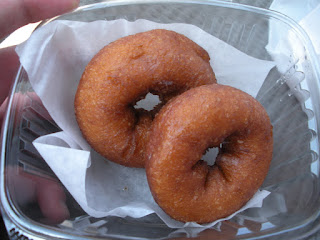
On my way out, I stopped in the store again and picked up, among other things, some donuts. I'm always a sucker for donuts, and these looked delicious. I'm happy to report that they did not disappoint. If you don't have a particularly sweet tooth, though, you may want to share one with somebody.

I'd never been, but enjoyed it, and recommend it if you're around Charlottesville. Especially if you want fruit. But you could also just go wander a little, it's got some nice views, as you might expect for the top of (what classifies around here as) a mountain.
 The white building in the middle of that picture is the UVA Hospital, or so.
After wandering around the little country store they've got, I decided I'd go pick some fruit. It's enjoyable to just walk around between fruit trees.

I was surprised to notice that not all types of apple grow the same. I have this image in my head of apple trees with all of the apples isolated, hanging from little stems. Apparently this isn't always the case (or perhaps today was just early in the season?). "Golden Ginger" (I think) seem to grow in pairs, right next to the branch:
 while these ones (possibly Red Delicious) grow more in clusters:
After a small sampling of apples, I wandered over to the peach section. The first several trees I saw had no obvious peaches, and I worried that I'd missed the season somehow. As I walked, though, the trees had more and more peaches. Some were a bit high for me (I saw people with little ladders, I wonder if you can rent them), but there were still plenty of delicious looking peaches in arms length.
 Many of these peaches are still ripening, so there's still time left this fall to get delicious peaches.
The peaches are on the opposite side of the mountain from cville, with more nice views:


I kinda liked this tree:

On my way out, I stopped in the store again and picked up, among other things, some donuts. I'm always a sucker for donuts, and these looked delicious. I'm happy to report that they did not disappoint. If you don't have a particularly sweet tooth, though, you may want to share one with somebody.

Sunday, July 19, 2009
Handling Personal Issues
I never have any idea what to do with students who are going through some sort of difficulty outside of the classroom. I understand that bad things happen all of the time, and there's never a good time for it. But at the same time, I don't see how it helps for a student to tell me what they are going through, even just in broad terms. They don't have to tell me if there is some family issue, or relationships, or health, or... anything. There are outside circumstances, I understand, and that's all I really need to know about.
But I don't know how to actually interact with these students when they come to my office and want to tell me what is going on. Most of me wants to stop them from talking about what, in any general or specific terms, is going on. There's nothing I can do about it. But I don't want to come across as not caring. Of course I'm sorry that they are going through whatever difficulty it is.
But I don't know how to actually interact with these students when they come to my office and want to tell me what is going on. Most of me wants to stop them from talking about what, in any general or specific terms, is going on. There's nothing I can do about it. But I don't want to come across as not caring. Of course I'm sorry that they are going through whatever difficulty it is.
Wednesday, July 1, 2009
Summer Calc II, Second Half
My summer calculus class is almost over. Not that I don't love teaching, or calculus, or that I don't like my students, but I won't mind when it's over. I've got plenty of other things I should be (and shouldn't be :)) working on this summer. But anyway. Our final exam is tomorrow.
Hopefully it will go better than the first midterm. Admittedly, the first midterm was after only 8 class periods, and had content from 4 different chapters. The exam I wrote is one I was pretty pleased with. Other instructors told me that it was conceptual, which I take as a complement. The average, though, was sadly low. Our final, tomorrow, only covers series. I don't think it's quite as interesting as the first, but other instructors seem to think it is still fair. So we'll see.
I approached series a little bit differently than I have in the past. The last few semesters, I've followed the outline of the book, starting with sequences, then series, on to convergence tests, power series, and wrapping up with Taylor series. I thought this semester I'd try to motivate the discussion of series a little differently. Instead of just "I'd really like to add up a bunch of numbers", I began with Taylor polynomials because "I'd really like to approximate a function". This felt like a good fit with the earlier material, when we found arc lengths (and similar things) by approximating the calculation with an easy one and taking a limit (and calling it an integral). So we're going to approximate a function by an "easy" one (polynomial) and then take a limit.
After that goal is set, it's easy enough to say that "good approximation" means "the derivatives match" (at the point in question), and derive the formula for the coefficients of the Taylor polynomial. Then I pointed out that we could do the process as long as we want and make polynomials of degrees as large as we wanted, and pointed out that this would end up looking very much like taking a limit.
Next I talked about power series in general, power series being what we get "in the limit" of our Taylor polynomial calculations. I talked about differentiating, integrating, and substituting into power series, to try to give some indication that they are useful and easy to work with. I'm not sure this part went over particularly well. It might have been better to do this later, with radius and interval of convergence (see below).
So once we have power series, I pointed out that evaluating a power series at a point meant you had to sum infinitely many values. But that we basically knew how, since we started with Taylor polynomials and took the limit. To sum infinitely many values, you just take a limit of partial sums. So I talked a little about general sequences and series at this point (and also spend an hour talking about fun examples - continued fractions, 3n+1 problem, koch snowflake, cantor set,...).
Then we had a whole day (2 hours of class, +/-) where I just talked about all of the convergence tests, followed by a day for them to work on convergence tests in class (work on homework, or just try other problems). I think that for a summer class, with the odd schedules and times, this almost works. During a normal semester, though, I wouldn't do things this way. I'd probably try to get the students to learn the problems from the book themselves. In fact, I did try this last semester, but that's a separate story.
My philosophy with the convergence tests (and most other topics) is that there isn't much point in my doing more than one or two examples at the board. Math is always easier when you watch somebody else do it. The only way to get comfortable with the convergence tests is to work a whole bunch of problems for yourself. Hopefully the longer-than-average assignment I gave my class helped them gain that comfort.
Once we have convergence tests, we can return to power series, and ask "for which x is this power series defined?" I like to think that this helped tie things together from our initial discussion of power series. I'm not convinced that's the case, but I'm also not sure how to tell (ask the students?). I think this maybe would be a better time for the discussion about how to manipulate power series than early on. I'll probably try it this way next time (this fall, for my fourth straight calc II class).
That covers all of the content for the series chapter. So then I spent a full class period talking about all sorts of fun and exciting uses of series. Today in class I gave them time to review (gave them a copy of last semester's exam, essentially), after answering whatever review questions they came in with.
I'm hoping this exam goes well. And that after it's all over, I have a productive summer.
Hopefully it will go better than the first midterm. Admittedly, the first midterm was after only 8 class periods, and had content from 4 different chapters. The exam I wrote is one I was pretty pleased with. Other instructors told me that it was conceptual, which I take as a complement. The average, though, was sadly low. Our final, tomorrow, only covers series. I don't think it's quite as interesting as the first, but other instructors seem to think it is still fair. So we'll see.
I approached series a little bit differently than I have in the past. The last few semesters, I've followed the outline of the book, starting with sequences, then series, on to convergence tests, power series, and wrapping up with Taylor series. I thought this semester I'd try to motivate the discussion of series a little differently. Instead of just "I'd really like to add up a bunch of numbers", I began with Taylor polynomials because "I'd really like to approximate a function". This felt like a good fit with the earlier material, when we found arc lengths (and similar things) by approximating the calculation with an easy one and taking a limit (and calling it an integral). So we're going to approximate a function by an "easy" one (polynomial) and then take a limit.
After that goal is set, it's easy enough to say that "good approximation" means "the derivatives match" (at the point in question), and derive the formula for the coefficients of the Taylor polynomial. Then I pointed out that we could do the process as long as we want and make polynomials of degrees as large as we wanted, and pointed out that this would end up looking very much like taking a limit.
Next I talked about power series in general, power series being what we get "in the limit" of our Taylor polynomial calculations. I talked about differentiating, integrating, and substituting into power series, to try to give some indication that they are useful and easy to work with. I'm not sure this part went over particularly well. It might have been better to do this later, with radius and interval of convergence (see below).
So once we have power series, I pointed out that evaluating a power series at a point meant you had to sum infinitely many values. But that we basically knew how, since we started with Taylor polynomials and took the limit. To sum infinitely many values, you just take a limit of partial sums. So I talked a little about general sequences and series at this point (and also spend an hour talking about fun examples - continued fractions, 3n+1 problem, koch snowflake, cantor set,...).
Then we had a whole day (2 hours of class, +/-) where I just talked about all of the convergence tests, followed by a day for them to work on convergence tests in class (work on homework, or just try other problems). I think that for a summer class, with the odd schedules and times, this almost works. During a normal semester, though, I wouldn't do things this way. I'd probably try to get the students to learn the problems from the book themselves. In fact, I did try this last semester, but that's a separate story.
My philosophy with the convergence tests (and most other topics) is that there isn't much point in my doing more than one or two examples at the board. Math is always easier when you watch somebody else do it. The only way to get comfortable with the convergence tests is to work a whole bunch of problems for yourself. Hopefully the longer-than-average assignment I gave my class helped them gain that comfort.
Once we have convergence tests, we can return to power series, and ask "for which x is this power series defined?" I like to think that this helped tie things together from our initial discussion of power series. I'm not convinced that's the case, but I'm also not sure how to tell (ask the students?). I think this maybe would be a better time for the discussion about how to manipulate power series than early on. I'll probably try it this way next time (this fall, for my fourth straight calc II class).
That covers all of the content for the series chapter. So then I spent a full class period talking about all sorts of fun and exciting uses of series. Today in class I gave them time to review (gave them a copy of last semester's exam, essentially), after answering whatever review questions they came in with.
I'm hoping this exam goes well. And that after it's all over, I have a productive summer.
Monday, June 15, 2009
Summer Calc II, Week 1
Last Tuesday I started teaching my summer Calc II course. We meet for 2 hours every day (M-F), and then the students also have a 45 minute discussion section with our TA. I decided to set up the course a little differently from how I've done Calc II the last few times, and thought I might try to describe some of it here.
The, say, "standard" way this course would go is to start with techniques of integration, do improper integrals, arc length and surface area of revolution, parametric curves, polar curves, iterated integrals, and then series. Last semester, we had one exam on techniques of integration and arc length and surface area, one on parametric and polar curves and iterated integrals, and one on series.
When I was setting up my course for the summer, I looked at how many days to spend on each topic, and how to try to schedule things best to naturally have exams and things. I decided to shoot for having all of the topics besides series as a single exam, around halfway through the course, and then have series be their own exam. We're just about to the first exam (it'll be Friday), and it looks like we can meet that schedule (with in class review time before the exam even!).
I was able to condense the material down in a few ways. First, the arc length and surface area calculations we do with usual $y=f(x)$ curves, we later redo with parametric curves (in the "standard" class). I decided to start with doing them as parametric and polar curves, and then make a few comments about how to convert a usual $y=f(x)$ curve to a parametric curve. [While I'm talking about surface area... I know that when you rotate around whichever axis, you have (sometimes) two choices for how to set up the integral. You could do it dy or dx. Probably I just haven't dug into enough examples, but is there one when the integral is "doable by hand" one way, but not "doable by hand" the other way, even though both can be set up?]
The other way I crunched things together was to leave more of the responsibility to the students to learn the techniques of integration on their own, outside of class, for homework. I made a few comments here or there, but largely it's been up to them. In my mind, the only real techniques of integration are u-substitution and integration by parts anyway, both of which I did talk about in class. The others, in the text, are trig integrals ("apply lots of trig identities"), trig substitution ("memorize a chart of what substitution to make when"), and partial fractions (I've got no beef with partial fractions). It wouldn't matter if I spent all day for a few class periods working integrals, the students would leave feeling like they weren't too bad, and would get stuck on them at home. So I cut out more of the "they aren't that bad" feeling, and mostly threw the students in to get stuck. My hope was that I'd see lots of kids in office hours, which has not (yet) been the case.
My other thoughts, along the lines of techniques of integration, are concerned with how useful they actually are. This general question is something me and every other math teacher with a blog have brought up before, especially recently with Wolfram Alpha doing integrals (and showing steps!). What is it we should actually be teaching these kids? I'm not convinced I've ever worked a trig-substitution integral outside of calculus class, but would love to hear about it if anybody out there had. Ok, sure, working them gives you lots of good practice with algebraic rules, and so I can now manipulate symbols like it's my job. But I've been trying to set up my class to sort of tend away from this. I really want to spend more time on, and get my students to answer more questions about, how to set up integrals to calculate things you might want to calculate, or what a given integral calculates (in a picture). I also try, when we work an integral, to talk them through any sort of consistency checking I would do for the answer (is it positive or negative? should it be? is it too big, or too small?). I like to think that I am giving them practice taking a problem and converting it to something a computer can easily do, and then thinking about if the answer is reasonable.
Part of my other goal in having them learn techniques of integration with somewhat less guidance, was to give them experience learning from the textbook directly. Probably I want to do this because it is how the calc class I took as an undergrad was set up.
I'm not convinced, based on homework grades, that things are going terribly well so far. I've asked them to give me anonymous feedback about any changes they want to have made, and tried to stress that I want them to ask questions and come to office hours. I've not gotten too much back in the way of feedback yet. The one, really, so far was that I should work harder problems in class. I think I get this every semester, so probably it is something I should seriously look into. But most of me thinks: they'll always look easier in class, you have to get stuck on them yourself. Math is not easy. I don't know, perhaps that's my laziness shining through. But at the same time, I can't really start with hard examples in class, because they won't make sense right away, and there's only so much time during class.
At some point I was preparing lectures and getting frustrated by the examples I had, and with trying to find new ones. (Is there a place online where teachers keep their favorite examples of all sorts of problems? Some sort of examples repository or something?) I came up with an idea I'm still mulling over for how to teach my classes. My thought was maybe I'll start each day with a little discussion about whatever new concepts there are for the day, at sort of the theoretical level. And then I'll just grab the first couple (or just one) odd problems from the text, and work through them. And then the rest of class time will be students working through as many more of the problems as we have time for. They can work in groups if they want, but don't have to. This gives them the chance to get stuck on problems, but quickly start asking questions to get over initial hurdles. They'll have their textbooks with them, to dig through examples, and will also have other students (and me) to ask when they're really stuck. Anybody have any thoughts on this setup?
The, say, "standard" way this course would go is to start with techniques of integration, do improper integrals, arc length and surface area of revolution, parametric curves, polar curves, iterated integrals, and then series. Last semester, we had one exam on techniques of integration and arc length and surface area, one on parametric and polar curves and iterated integrals, and one on series.
When I was setting up my course for the summer, I looked at how many days to spend on each topic, and how to try to schedule things best to naturally have exams and things. I decided to shoot for having all of the topics besides series as a single exam, around halfway through the course, and then have series be their own exam. We're just about to the first exam (it'll be Friday), and it looks like we can meet that schedule (with in class review time before the exam even!).
I was able to condense the material down in a few ways. First, the arc length and surface area calculations we do with usual $y=f(x)$ curves, we later redo with parametric curves (in the "standard" class). I decided to start with doing them as parametric and polar curves, and then make a few comments about how to convert a usual $y=f(x)$ curve to a parametric curve. [While I'm talking about surface area... I know that when you rotate around whichever axis, you have (sometimes) two choices for how to set up the integral. You could do it dy or dx. Probably I just haven't dug into enough examples, but is there one when the integral is "doable by hand" one way, but not "doable by hand" the other way, even though both can be set up?]
The other way I crunched things together was to leave more of the responsibility to the students to learn the techniques of integration on their own, outside of class, for homework. I made a few comments here or there, but largely it's been up to them. In my mind, the only real techniques of integration are u-substitution and integration by parts anyway, both of which I did talk about in class. The others, in the text, are trig integrals ("apply lots of trig identities"), trig substitution ("memorize a chart of what substitution to make when"), and partial fractions (I've got no beef with partial fractions). It wouldn't matter if I spent all day for a few class periods working integrals, the students would leave feeling like they weren't too bad, and would get stuck on them at home. So I cut out more of the "they aren't that bad" feeling, and mostly threw the students in to get stuck. My hope was that I'd see lots of kids in office hours, which has not (yet) been the case.
My other thoughts, along the lines of techniques of integration, are concerned with how useful they actually are. This general question is something me and every other math teacher with a blog have brought up before, especially recently with Wolfram Alpha doing integrals (and showing steps!). What is it we should actually be teaching these kids? I'm not convinced I've ever worked a trig-substitution integral outside of calculus class, but would love to hear about it if anybody out there had. Ok, sure, working them gives you lots of good practice with algebraic rules, and so I can now manipulate symbols like it's my job. But I've been trying to set up my class to sort of tend away from this. I really want to spend more time on, and get my students to answer more questions about, how to set up integrals to calculate things you might want to calculate, or what a given integral calculates (in a picture). I also try, when we work an integral, to talk them through any sort of consistency checking I would do for the answer (is it positive or negative? should it be? is it too big, or too small?). I like to think that I am giving them practice taking a problem and converting it to something a computer can easily do, and then thinking about if the answer is reasonable.
Part of my other goal in having them learn techniques of integration with somewhat less guidance, was to give them experience learning from the textbook directly. Probably I want to do this because it is how the calc class I took as an undergrad was set up.
I'm not convinced, based on homework grades, that things are going terribly well so far. I've asked them to give me anonymous feedback about any changes they want to have made, and tried to stress that I want them to ask questions and come to office hours. I've not gotten too much back in the way of feedback yet. The one, really, so far was that I should work harder problems in class. I think I get this every semester, so probably it is something I should seriously look into. But most of me thinks: they'll always look easier in class, you have to get stuck on them yourself. Math is not easy. I don't know, perhaps that's my laziness shining through. But at the same time, I can't really start with hard examples in class, because they won't make sense right away, and there's only so much time during class.
At some point I was preparing lectures and getting frustrated by the examples I had, and with trying to find new ones. (Is there a place online where teachers keep their favorite examples of all sorts of problems? Some sort of examples repository or something?) I came up with an idea I'm still mulling over for how to teach my classes. My thought was maybe I'll start each day with a little discussion about whatever new concepts there are for the day, at sort of the theoretical level. And then I'll just grab the first couple (or just one) odd problems from the text, and work through them. And then the rest of class time will be students working through as many more of the problems as we have time for. They can work in groups if they want, but don't have to. This gives them the chance to get stuck on problems, but quickly start asking questions to get over initial hurdles. They'll have their textbooks with them, to dig through examples, and will also have other students (and me) to ask when they're really stuck. Anybody have any thoughts on this setup?
Subscribe to:
Posts (Atom)
